
Thank you for visiting the Old Shebbearian Association, we now have our own section of the Shebbear College website where all news and updates will be published.
Do have a look! https://www.shebbearcollege.co.uk/our-community/old-shebbearians-association/about-us/
Shebbear College was honoured to host “Ted’s Tea” following the funeral of Ted Lott at Lake Chapel on Friday 2nd June. Over 300 people came to say their goodbyes to Ted, a former pupil, governor and OSA President, a true Shebbearian.
Ted was born at 3 Gables, Woosery on 7th July 1931. The only son of Arthur and Alice Lott.
“It is hard to think of anyone who embodied the spirit of both Shebbear and Shebbear College more than Ted Lott.
Ted and his wife Sheila were always splendid company – extremely well informed about the world, genuinely concerned about everyone’s wellbeing and most of all jolly good fun. Sheila was still amused that to some extent despite all those years in the shire, she was still considered an ‘incomer’ and she was always available for advice on life in North Devon – usually over a magnificent tea.
Ted was the guardian of Lake Chapel. His car was parked outside most mornings (most people felt safer when it was parked rather than in motion) and he spent many evenings there as the Newton Petrock choir got together for practice. On the warmest and coldest of evenings, it was a joy to hear the sounds of their rehearsals drifting across the school grounds.
Ted had been a boy at the College during the Second World War and told a vivid story of the boys gathered together listening to Winston Churchill on the radio. He also remembered seeing the glow of the fires in Plymouth above Dartmoor after it fell victim to German bombing raids. Ted later devoted many years of his life as a Governor of the College from 1967 to 1993 – the latter years involving some turbulent moments which must have challenged this very gentle man.
Ted loved Shebbear College and was always willing to help it in any way he could. A high point came in 2017, when the College hosted the Methodist Independent Schools Trust for its annual conference, Ted welcomed the delegates to his Chapel and they immediately fell in love with him for his humour and his accent. The follow up speaker was Michael Morpurgo – two great story tellers on the same bill.
For the dog walkers and wildlife lovers of Shebbear, Ted and Sheila created ‘Sheila’s Folly’ on the road to Stibbs Cross. This was a typically enlightened, far sighted and altruistic act which will benefit generations to come. Ted was a delightful and very kind man. A man with a simple, but strong faith and noble intentions. God bless his soul.”
Simon Weale – former Headmaster
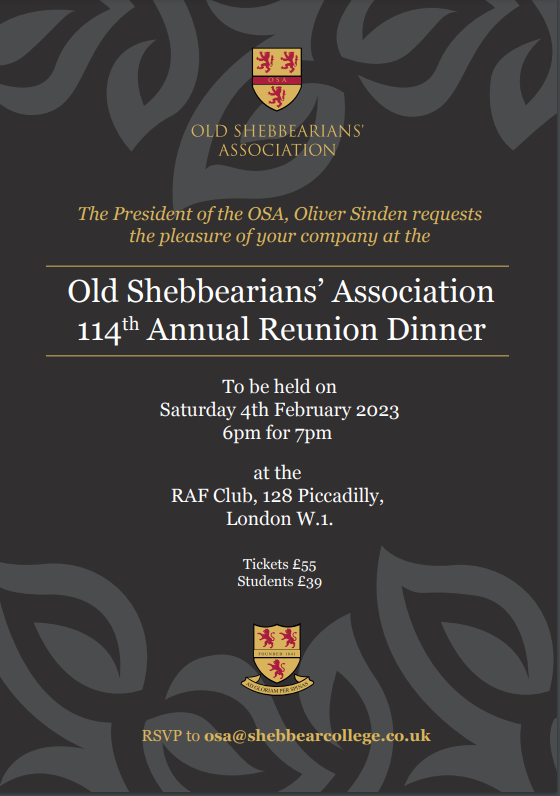
115th OSA Reunion Dinner – Saturday 4th February 2023
72 Old Shebbearians and guests attended the Annual Reunion Dinner, held once again at the RAF Club in London earlier this month.
The President started proceedings, after the guests had been welcomed, by asking those present to remember those OS pupils and staff who had passed in the last year and who are listed below:
Elizabeth Hocking
Geoffrey Wrayford
Richard Saunders
John W Tatum
David Pugsley
Tim Lillywhite
Shebbear College Staff
Ian Rowbury
Keith Tewkesbury
Tom Danby
Governor
Geoff Giddy
After the meal, President Oliver Sinden welcomed the new head, Charlie Jenkins and went on to say how much he had enjoyed the several opportunities he had had to visit the College in the past year – commenting on the different system of presenting prizes and how, unsurprisingly, the weather had played a part in deciding the venues for the occasions. He emphasised his belief that the long term benefits of his time spent at College were just as much, if not more, social than academic.
The head, Charlie Jenkins then responded, describing some of the difficult situations he faced as Deputy Head – from a flock of sheep loose on Tower Field to the loss of the roof on Pollard House during storm Eunice! However, the refurbishment of both Pollard and Ruddle is now close to completion and, together with a refurbished all weather pitch and an enhanced digital infrastructure ready for roll-out in September, the site remains safe and compliant for all Shebbearians and, more importantly, the College remains as strong as ever.
The heads of school, Roy Poon and Jack Hancock, then responded most impressively recounting some of their experiences at the College –all of which they seemed to think were character building –and then listed just a few of the sporting and dramatic achievements which have been recorded in the past year before proposing a toast to the College and the OSA.
Pip Mahoney then spoke on behalf of the OSA adding his own amusing anecdotes of his time at the College and emphasising the importance of the extra-curricular as well as the academic life and how Shebbear should be considered highly successful in developing the whole self.
The Dinner ended with the singing of the School song and conversations between Old Shebbearians continued late into the night.
Final reminder to get your tickets, looking like a busy one this year!

Bank Transfer Details as follows:
Nat West Account
Old Shebbearians’ Association
Acc. No. 45466971
Sort Code 60-05-37
| With deep regret I inform you of the passing of the above Old Boy. He died on 22nd October’22 after a long battle with cancer. Both his children Ben and Jade were by his side at the end. He was a superb centre back with a mammoth crash tackle. He will be missed by all who knew him. His friend – John Flinn 59-67. Captain of Pollard House. |
We have received news today that Rev Geoffrey Wraford has passed away. His funeral is being held Monday 30th May, 2pm Lympstone Parish Church.
I decided to do a skydive because I wanted to mark my 18th birthday by doing something for a charity close to my heart. I chose Devon Mind in memory of my Uncle Ev and I hope by raising awareness about mental well-being and funds for such an amazing charity, that others can access the help they need from the services provided.
I am doing a tandem skydive from 15,000ft on Wednesday the 27th of April at Midday – any donations are gratefully received!
This is the ‘just giving page’ link :
https://www.justgiving.com/fundraising/BellaR-skydive-DevonMind?utm_campaign=lc_frp_share_transaction_transactional_–_donation_received_–_nth_donation&utm_content=93fba9cf-af6a-4da6-ae56-479417c46d73&utm_medium=email&utm_source=postoffice&utm_term=1648636872170
© 2026 Old Shebbearians' Association
Theme by Anders Noren — Up ↑